
.jpg)
OUR BREADS (all leavened)
Country Classic 850 / 1000 / 1200 - (90/10)
Ingredients: white (90 baker's %) & whole wheat (10%), water, salt, liquid levain.
Free form (bâtard for 800; boule for 1000 & 1200)
Three sizes: 850g, 1kg, 1.2kg
Country Sunflower (90/10)
Ingredients: white (90 %) & whole wheat (10%), water, salt, sunflower seeds, liquid levain.
Free form (bâtard)
Country Rye (75/25)
Ingredients: white (75 %) & whole rye (25%), water, salt, liquid levain.
Free form (bâtard)
Prairie (75/25)
Ingredients: white & whole wheat flours, malt, water, yeast (dry instant), salt, poolish, soaker (seeds: flax, sunflower, pumpkin, sesame; rolled oats)
Free form (bâtard)
Finnish Rye (25/25/50)
Ingredients: whole rye (25 %), white (25%) & whole wheat (50%) flours, water, salt, molasses, yeast (dry instant), wheat soaker (cracked), flaxseed soaker, liquid levain.
Form: loaf pan
Brioche Nanterre (650g)
Ingredients: high-protein white flour (12.5% min), whole milk, eggs, unsalted butter, sugar, malt, salt, levain.
Form: loaf pan
Chocolate Babka (600g)
Ingredients: white flour, whole milk, eggs, unsalted butter, sugar, salt, starter, bittersweet chocolate, unsweetened cocoa powder.
Form: braid, loaf pan
Ciabatta (300g)
Ingredients: high-protein white flour (12.5% min), hard red whole wheat, water, salt, olive oil
Form: sandwich-size buns
ON LEAVENING
Leaven /ˈlevən/
Noun
-
a substance, typically yeast, that is used in dough to make it rise.
-
pervasive influence that modifies something or transforms it for the better.
"they acted as an intellectual leaven to the warriors who dominated the city"
Verb
-
cause (dough or bread) to rise by adding yeast or another leavening agent.
"it only take a little bit of yeast to leaven the bread"
2. permeate and modify or transform (something) for the better.
"the proceedings should be leavened by humour"
Oxford Languages / Google, OUP, 2025.
----
For us, a leaven (or levain starter) is an off-shoot of the sourdough starter;
a mixture of fresh flour, water, and some ripe starter.
Typically, we use all of the the mixture in a batch of dough, the following, or 3rd day.
It is a preferment, meaning it will leaven the dough (make it rise)
and be responsible for the flavour produced through the byproducts of fermentation.
Levain, in the original French, has a broader meaning, covering both the starter and the leaven.
In the post-80s and especially after 2000, wild yeast cultures have regained popularity.
The "pain au levain (traditionnel)" is typically what we call "sourdough",
marking a clear break from breads based on the "levure" (commercial yeast).
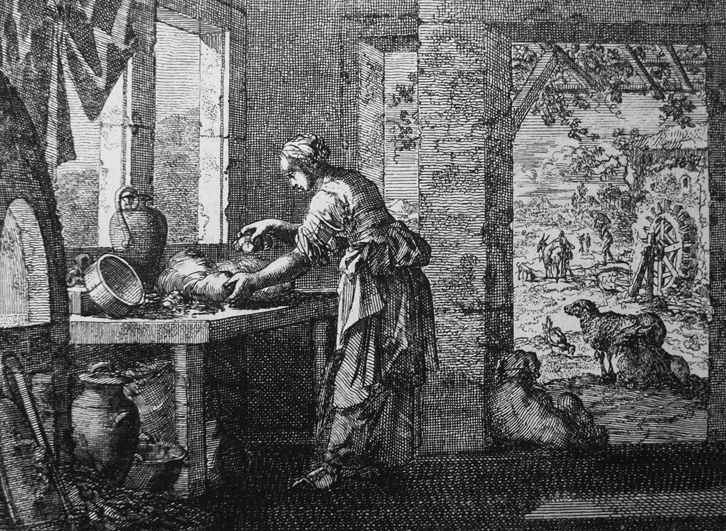
Parable of the Leaven, etching by Jan Luyken, Bowyer Bible, Matthew 13: 30-34, Bolton, England, 1712.
Attribution: Phillip Medhurst / Harry Kossuth, FAL, via Wikimedia Commons
ON FERMENTING
We allow our breads to ferment a minimum of 36 hours. It develops flavour, reduces gluten and naturally extends shelf life.
Time as the main ingredient.
Fermentation as (microbial) terroir, in David Chang's words. My Edmonton starters will develop their own character, which will have little in common with one grown in the more pervasively dry climate of the Sierra Nevada, or one nurtured in the rarefied air of Leadville, Colorado. Mold, yeast and bacteria as responsible for fermentation, and composing flavour with local attributes. "(...) microbes indigenous to any given region will always have their say in the flavour of the final product, in the same way that soil, weather, and geography affect wine."
But what makes fermentation so good? "On their own, starch and protein molecules are too large for our bodies to register as sweet or umami-rich. However, once broken down into simple sugars and free amino acids through fermentation, foods become more obviously delicious. Koji made from rice has an intense sweetness that plain cooked rice doesn't. Raw beef left to ferment into garum has a savouriness that speaks to us on a primitive level."
So we hope to bring to your table bread as more than a platform for your confiture or your honey.
An expression of flavour that can stand on its own, or with just a shaving of butter.
Fermentation through and through.
Credits: Rene Redzepi & David Zilber, The Noma Guide to Fermentation, Artisan (Workman Publishing Co.), 2018, pp. 11 & 28.


OUR FLOURS
Coming soon!
ABOUT US
As a child, on Sunday mornings, after the final pealing of the bells of our Dominican parish, a stop at the bakery, just on the other side of the border, in the French region of Haute-Savoie, was one of our cherished rituals as a family. The tearing, parcelling out, and nibbling through an olive fougasse, as I would sit at the back of the car and we were making our way back home, was one of those small weekend joys. The experience was, as Roald Dahl would say, quite gloriumptious, and the fougasse - as well as endlessly flaky pains au chocolat that were included in the paper bag - ending far down most of our bellies miles before reaching the kitchen counter. It was my madeleine de Proust: from the moment I entered the little store, the smell of olives and the residual heat from the deck ovens would take over. A pattern of scent and flavour I could come back to, week after week.


Years later, far from the Alps of my origins, I gradually reconnected with bread through sit-down breakfasts, cheese boards, par-baked baguettes, pandemic habits of discovering what a kitchen can do, staring at rising dough, and neighbour-to-neighbour deliveries - distanced, but warm nonetheless. It was nostalgia, as well as the need to connect heart, mind and body after a work injury that made me reconsider the use of my hands. So I made the leap to learn the skill and the language of bread south of our Canadian border. Lots of unlearning; breaking down those assumptions about taste, texture; and stretching what the palate can do, beyond those ingrained habits with sugar, salt, and sour. Time shared also with many along their own journeys, at the bench, the oven, the lunch table, whether through learning, working those 2am-2pm shifts, or just exposure to the community of bread makers and believers. Whatever the generation, i.e sooner or later, and despite the "bad press" on gluten, we all tend to gravitate - or oscillate back - to bread, don't we?


Credits: SFBI (all above)
ON RECONCILIATION: ACKNOWLEDGEMENTS
We are grateful to those whose territory we reside and operate on. Treaty 6 was entered into in 1876. For almost 150 years, we have been living, working, and growing on this land that is the ancestral and traditional territory of the Cree, the Nakoda Sioux, the Dene, the Saulteaux, as well as the Métis and Inuit who have lived in and cared for these lands for generations. We acknowledge this land is also within the historical Northwest Métis Homeland which includes the North Saskatchewan River Territory, the Lesser Slave Lake Territory, and the Lower Athabasca Territory. We acknowledge the Traditional Knowledge Keepers and Elders, both past and present, and are grateful for their contributions that helped keep this land beautiful. We make this acknowledgement as an act of reconciliation.
Further, we refer to the TRC's 2015 Report. Leaven & Rise recognizes the lived reality of our Indigenous brothers and sisters. In particular, as a business, we will endeavour to implement, when and where possible, the Call to Action 92. iii: Provide education for management and staff on the history of Aboriginal peoples, including the history and legacy of residential schools, the United Nations Declaration on the Rights of Indigenous Peoples, Treaties and Aboriginal rights, Indigenous law, and Aboriginal–Crown relations. This will require skills based training in intercultural competency, conflict resolution, human rights, and anti-racism.
OUR NEWSLETTER
Coming soon!